








From CRA Requirements to Lifecycle Control
The Cyber Resilience Act (CRA) introduces binding cybersecurity requirements for products with digital elements across their entire lifecycle. Addressing these requirements in practice demands technical mechanisms that translate regulatory provisions into operations, enforceable control, and maintain their effectiveness after deployment.
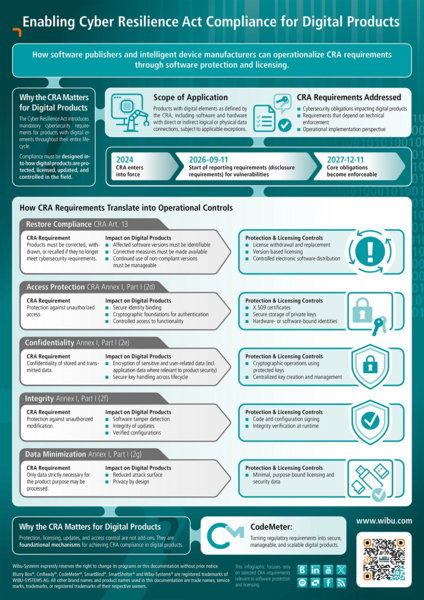
The CRA establishes a comprehensive framework of cybersecurity requirements for products with digital elements, addressing areas such as access protection, data confidentiality and integrity, data minimization, and the ability to restore compliance when vulnerabilities emerge. The regulation follows a risk-based approach and deliberately avoids prescribing specific technical implementations. This places the responsibility on manufacturers to translate regulatory expectations into practical, product-level controls.
The first infographic highlights how selected CRA provisions can be addressed through technical protection and licensing mechanisms that support version identification, access restrictions, update handling, and corrective measures. The emphasis is on ensuring that manufacturers retain the technical ability to manage product states, react to vulnerabilities, and maintain compliance where required. In this context, software protection and licensing provide a structured way to put CRA expectations into practice.
However, compliance does not end once a product is released. CRA obligations persist throughout operation, maintenance, and end-of-life. The second infographic illustrates how licensing can function as a continuous control layer across the digital product lifecycle, supporting activation, controlled use of configurations and features, remediation processes, and secure handling of products and data at end-of-life.
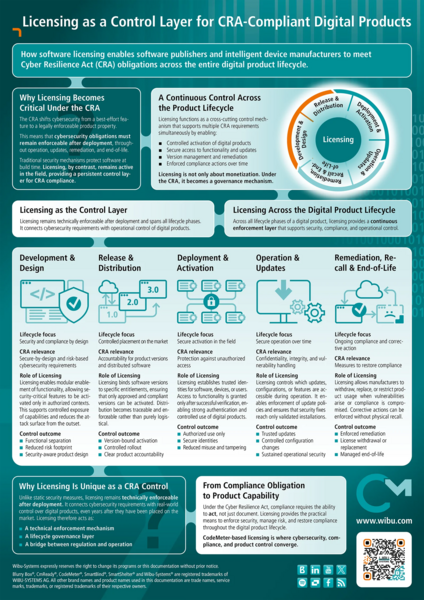
Together, the two infographics show a coherent path: from interpreting CRA provisions as technical requirements, to sustaining operational control over time.
KEYnote 51 – Edition Spring/Summer 2026