





Still Shipping Parts, or Printing Them On Demand?
Additive manufacturing (AM) has become an established part of industrial production. According to the Wohlers Report 2026, global AM revenue reached $24.2 billion in 2025, an increase of nearly 11% over the previous year. For the first time, production parts account for the largest share of additively manufactured components. What was once a niche technology for prototyping has become an established part of industrial production, and the question of how to protect and monetize the underlying 3D printing data is now moving to the center of business strategy.
Two Emerging Growth Drivers: Robotics and Defense
Alongside established sectors such as automotive and aerospace, two markets are currently driving particularly strong growth.
Robotics: Additively manufactured components are increasingly becoming part of robots themselves. Customized grippers, lightweight structures for robotic arms, and housings with integrated functions are produced directly from 3D printing data and subsequently processed in automated cells. This places the digital component model at the heart of the connected production line, where it moved through design, integration, and manufacturing systems. As a result, this digital asset deserves the same level of protection as conventional CAD data. Without control over access and production quantities, a distributed print file can be used to manufacture unauthorized copies at any point in the chain.
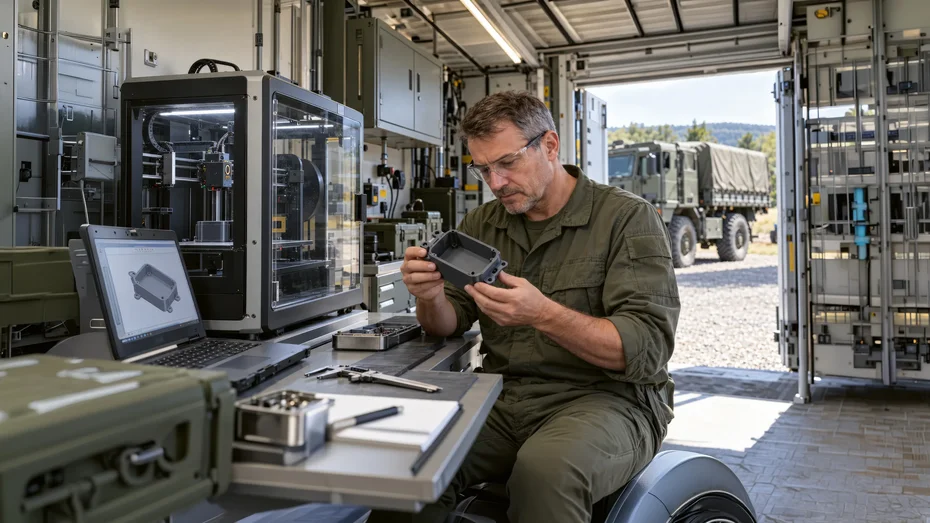
Defense: The trend is even more pronounced in the defense sector. The U.S. Department of Defense has nearly doubled its additive manufacturing budget for 2026, from approximately $1.8 billion to $3.3 billion. Analysts currently value the global additive manufacturing in defense market at $5 billion, with a projected growth rate of more than 17% through 2035. European and international defense programs are also increasingly adopting 3D-printed spare parts, drone components, and manufacturing directly in operational areas, including mobile printing centers that produce parts in the field. The reason is clear: On-demand production that is independent of long, vulnerable supply chains offers armed forces a strategic advantage.
Yet this decentralization also creates the greatest risk. As more partners, service providers, and field units require access to digital blueprints, the exposure to product piracy, espionage, and unauthorized manufacturing increases. For safety-critical or classified components, the consequences can be particularly serious.
A Complex Process, a Proven Solution
The fundamental challenge remains unchanged: At the beginning of the process chain is a digital design that represents the manufacturer's intellectual property. Today, that design may pass through integrators, local 3D service providers, or even mobile field systems before it is actually printed. Control over its use and the number of parts produced must be maintained at every stage.
Wibu-Systems has been reliably addressing this challenge with CodeMeter technology for years. Digital blueprints are cryptographically encrypted, while the keys are securely distributed as licenses, available worldwide around the clock. Distribution is also possible offline through file exchange, which is essential for isolated defense environments or autonomous field units. A preparation license permits the processing of print data, while a separate, order-specific print license limits production quantities through a tamper-resistant Unit Counter. This protects intellectual property at every stage, from the designer and integrator to the printer on site, regardless of how many stages are involved.
Ready-to-use CodeMeter libraries are available for manufacturers of preparation software and 3D printers across numerous platforms and programming languages. Secure license storage options range from cloud licenses (CmCloudContainer) and software-based activations (CmActLicense) to hardware dongles (CmDongle) where the highest level of protection is required, such as in defense environments. Centralized license management and rollout are handled by CodeMeter License Central, which integrates seamlessly with existing back-office systems.
From Pilot Project to Production Blueprint
What began several years ago as a pilot project with an automotive manufacturer is now an established production application: Daimler Buses uses CodeMeter to protect and monetize 3D-printed spare parts. This model, a protected digital object with transparent control over production quantities, can be applied directly to the requirements of emerging growth sectors, from robotic production lines to highly sensitive components for defense and security. As additive manufacturing becomes increasingly integrated into critical infrastructure and supply chains, transparent licensing and protection technologies such as CodeMeter become all the more important.
KEYnote 52 - Edition Fall/Winter 2026